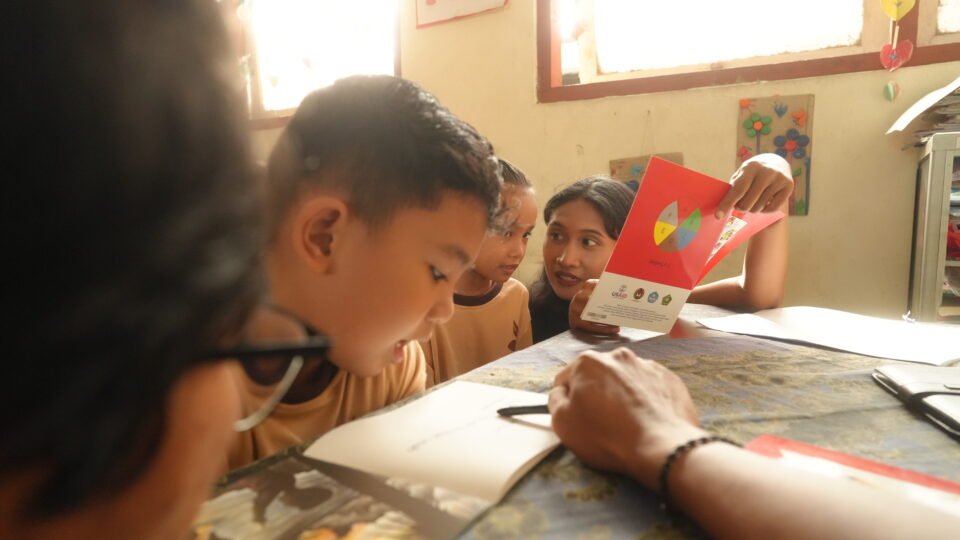
At a wooden desk in a classroom at SDN Cepaka, a child opens a picture book while a companion sits alongside, pointing line by line with the tip of a pen. The scene is quiet. That’s the literacy class assessment at SDN Cepaka, an early screening to find out which students in grades 1 to 3 still can’t read.
The activity continues a literacy program that began earlier with teacher training at Kimnara Space. Before literacy classes open, the team needs to know where each child should start.
Why Does the Assessment Come First?
Teaching a whole class to read the same way rarely works, because the children in it sit at very different levels. Some already read sentences smoothly, some still sound out syllables, and some don’t yet know their letters with confidence. The balanced reading approach brought by Yayasan Literasi Anak Indonesia is built on that reality. Children are grouped by ability, then guided with books pitched at the right difficulty.
The books themselves are leveled, from the simplest tier up to more challenging ones. To pick the right level, teachers first have to know each student’s ability. That’s the assessment’s job. Without this step, a fluent reader gets bored by a book that’s too easy, while a child who doesn’t know their letters yet sinks into one that’s too hard.
Read also: Balanced Reading Training at Kimnara Space by YLAI
What Happens at the Assessment Desk?
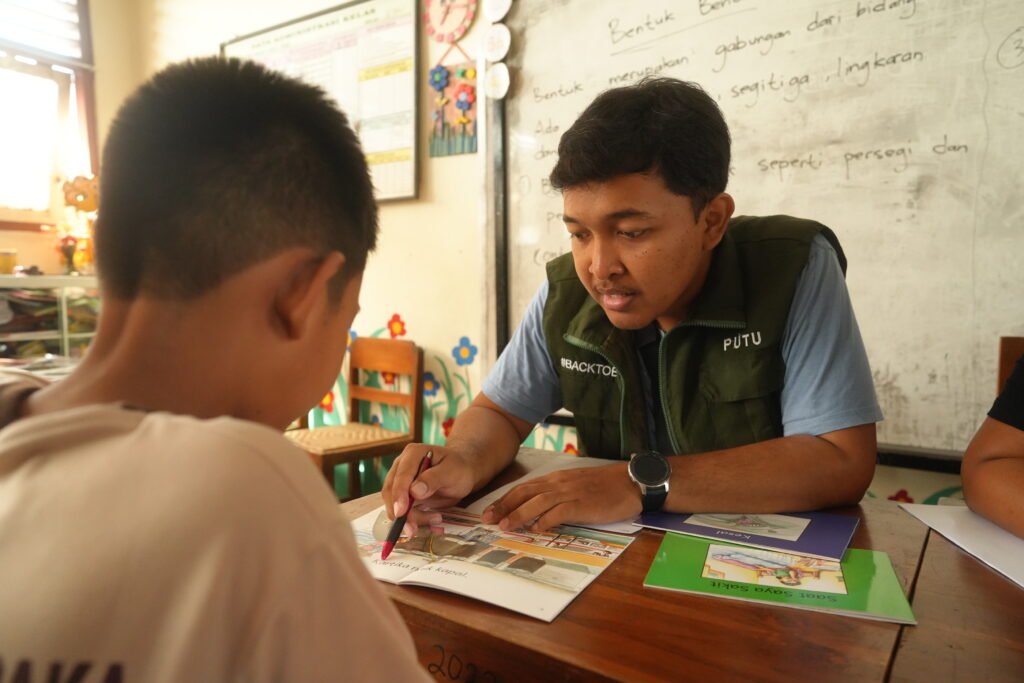
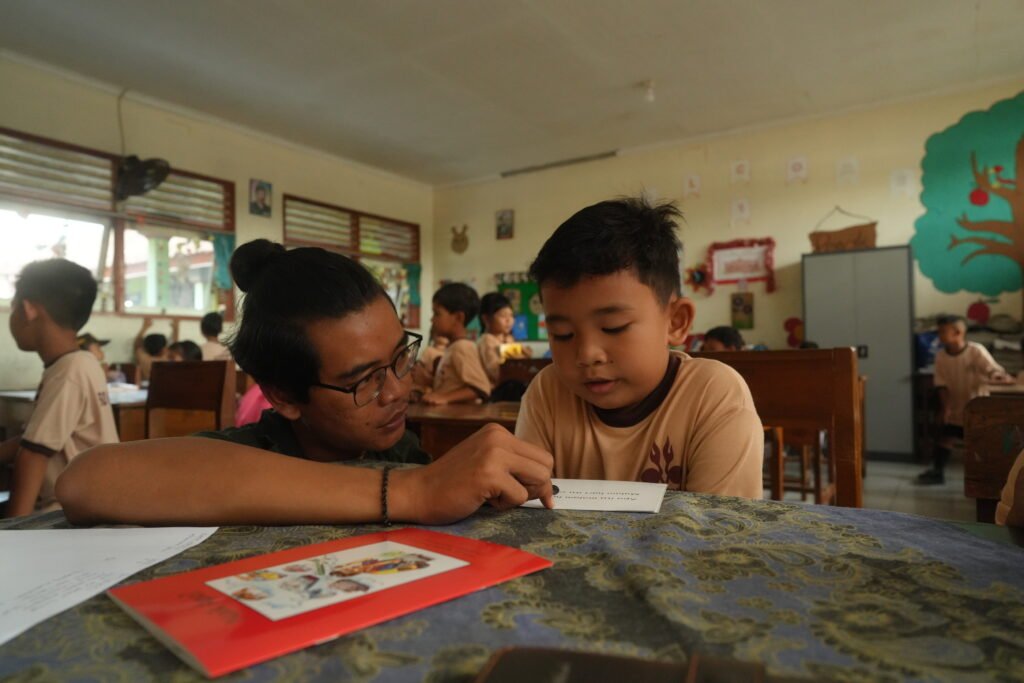
The assessment at SDN Cepaka happens individually. Each child reads aloud directly to a companion, who tracks every line with a finger or a pen. That makes it easier to catch subtle things a worksheet can’t show: whether a child reads letter by letter, syllable by syllable, or word by word, where they stop, and how they react when a hard word appears.
Early reading assessments generally move in steps, from recognizing letters, to blending syllables and words, to reading simple sentences. With that sequence, a companion can see exactly which rung of the ladder a child is standing on.
The books in the photos carry large illustrations and short sentences about everyday things, like riding a bicycle or taking a boat. One cover includes a lettered circle that seems to mark the reading level. From how a child handles a book like that, the companion can judge which level makes a good starting point.
The word assessment easily sounds like a test, especially to a first grader. The purpose is different. The aim isn’t to find children who fail. It’s to find children who need support first, so help arrives quickly, before the gap grows.
The results aren’t a verdict either. A young child’s reading ability keeps changing: a child still sounding out words today can jump far ahead within a few months with the right guidance. That’s why assessment results work best as a starting map for teachers, and shouldn’t be announced to a whole class.
The first three years of elementary school are when children learn to read. After that, they read to learn: word problems in math, social studies texts, instructions for experiments. A child who reaches grade 4 without a firm reading foundation will struggle in nearly every subject, including those with no connection to language class. YLAI’s balanced reading program targets grades 1 to 3 for exactly that reason.
SDN Cepaka and the Story Already Unfolding Together
SDN Cepaka isn’t a new face in COCO Social Fund’s programs. On September 28, 2026, the school hosted the Return It station in the Cepaka Waste Journey, where SMP Kalam Kudus students learned school-scale organic waste processing. Now the same school hosts a literacy assessment.
Two programs that look different, waste and reading, meet in the yard of one village school. For readers following community empowerment in Cepaka Village, the pattern is easy to read. A foundation builds a long-term relationship with one community, then adds layers of programming one at a time.
Read also: Cepaka Waste Journey: When an SMP Kalam Kudus Field Trip Turned Into a Passport Adventure
For any company or partner weighing a CSR program in Bali, foundational literacy has one clear advantage: the results last. A child who reads fluently keeps using that skill, in the next school and all the way into the workforce.
Closing Thoughts: It Starts With Listening
The literacy class assessment at SDN Cepaka looks simple: a child, a book, a patient companion. But from those small desks, a map of an entire grade’s reading ability starts to take shape, and from that map, literacy classes can be designed to hit the mark. It’s one of those educational activities for children in Bali whose impact only shows months later.
If a child in the early grades at your home still stumbles while reading, there’s a small step worth trying. Read one short story aloud every day, point to each word with a finger as you go, let the child pick the book, and hold back from cutting in every time they slip. Ten consistent minutes often does more than one forced hour.