Picture needle and thread meeting thousands of meters of red and white fabric, stitched hand by hand until it stretches past 2.57 kilometers. Not a one-night job, and definitely not a one-person project. That’s what COCO Social Fund has been preparing ahead of this year’s 81st Indonesian Independence Day — a Merah Putih Flag 2.57 KM long, aiming to become the longest ever unfurled in Bali.
The number 2.57 kilometers wasn’t picked at random. There’s logic behind it: marking 81 years of Indonesian independence deserves something that feels equally big, something that pulls many hands together at once.
Why a Flag 2.57 Kilometers Long?
Several Indonesian provinces have already set similar records — some stretching well over ten kilometers of red-and-white fabric through collaborations involving thousands of students. COCO Social Fund took a different approach here, though: not a race for a national headline, but an achievement that actually fits Bali’s scale.
If it comes together as planned, this 2.57 km stretch could become the longest Merah Putih flag ever unfurled on the island. It’s more than a nationalism symbol. It’s also proof that a social foundation in Bali can rally residents around something entirely separate from the environmental or social aid programs they usually run.
On paper, sewing a flag that long sounds straightforward. In practice, the logistics get complicated fast.
Fabric, Sizing, and Official Flag Proportions
The Indonesian flag follows a fixed ratio — 3 to 2, length to width. Stretched across 2.57 kilometers, that means sourcing an enormous amount of fabric, then stitching it piece by piece into one unbroken length.
Not a job finished overnight. The sewing usually happens in stages, with many hands working at different points, before everything comes together ahead of the unfurling day itself.
Who’s Doing the Sewing?
This is where the gotong royong spirit — Indonesia’s tradition of communal mutual aid — really shows. Cepaka Village residents, COCO Social Fund volunteers, and likely students and local community groups all take part in the sewing process.
This kind of work pattern isn’t new for COCO Social Fund. The foundation is known for running community empowerment work in Cepaka Village through various programs, from plastic waste processing to environmental education. This giant flag project adds a new form of collaboration — this time centered on nationhood rather than the environment.
It might sound like a departure from the foundation’s usual lane. An organization known for plastic pyrolysis and environmental education suddenly leading a giant flag project. But look closer, and it actually fits their broader mission: building community.
Independence Day celebrations are one of those rare moments when people from all walks of life show up without needing to be asked twice. COCO Social Fund seems to have spotted that as an opportunity to strengthen residents’ sense of ownership over their own village — something that lines up with what a CSR program in Bali can look like when it’s not only about donations, but about building togetherness.
From Needle and Thread to the Village Road
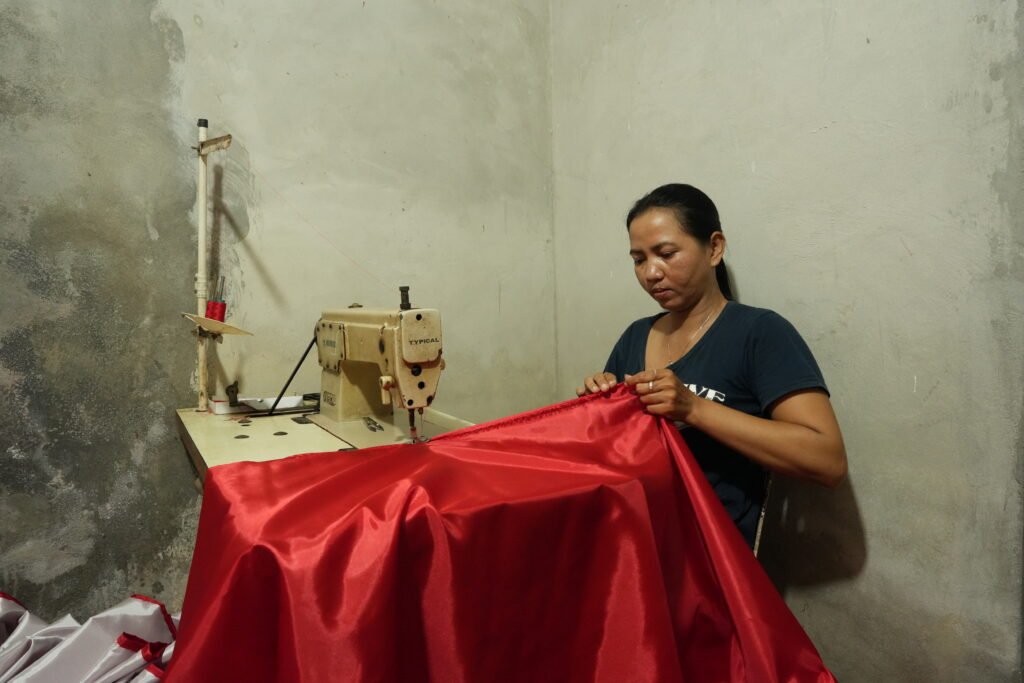
Once the sewing wraps up, the next challenge is logistics. A 2.57-kilometer length of fabric isn’t easy to move, let alone lay out neatly along a road without tearing or bunching.
It takes careful coordination — a defined start and end point, enough people spaced along the route to hold the fabric steady, and traffic management around the site. Events at this scale typically also involve village officials and local police, given how much larger this is than a typical community gathering.
There’s something personal about a hand-sewn flag that a factory-made one can’t replicate. Every stitch carries the time and effort of the person who made it — whether that’s a villager squeezing it in between work, or a volunteer who showed up specifically to help.
Similar stories have played out across Indonesia during past Independence Day celebrations. One village reportedly spent a full month sewing a one-kilometer flag, involving more than a thousand residents. The process was exhausting, but the result always carries its own story worth retelling for years.
The Merah Putih Flag 2.57 KM led by COCO Social Fund will likely carry a similar story — not just about how long the fabric stretches, but about how many people chose to give up their time for a single piece of cloth that means far more than its size suggests.
A Moment for Cultural Preservation and National Spirit in Bali
There’s another angle worth noting here: how a national celebration can sit comfortably alongside local Balinese identity. The gotong royong spirit behind sewing the flag isn’t far removed from ngayah — the long-standing Balinese concept of communal work done without expecting anything in return.
Seen this way, the giant flag project reinforces COCO Social Fund’s place within the broader Bali environmental and cultural community — not limited to waste and environmental issues, but also nurturing national spirit through something that feels close to local cultural roots.
Read also: Melaspas Kimnara Space: A New Coworking Hub Blessed the Balinese Way
Every year, August 17th celebrations bring the usual mix of pole-climbing competitions, parades, and flag ceremonies on the village field. The Merah Putih Flag 2.57 KM offers a different way to mark independence — not through competition, but through a long collaboration that demands patience and teamwork from start to finish.
For residents of Cepaka Village and beyond, this is a rare chance to take part in something on a much bigger scale, while getting a firsthand feel for the process behind a national symbol they’ve otherwise only ever seen flying from a distance.
Closing Thoughts: One Piece of Fabric, Many Hands, One Spirit
The Merah Putih Flag 2.57 KM isn’t just a number chasing a milestone for Indonesia’s 81st Independence Day. It’s a story about how a social foundation in Bali can rally residents around something bigger than themselves.
If it stretches fully across the road in Cepaka Village as planned, this flag will stand as a reminder that independence isn’t only celebrated through formal ceremony — it can also be marked with needle, thread, and thousands of hands willing to work together on one shared piece of cloth.