Quiet work in a small village doesn’t usually travel far. But every so often it does, and toward the end of August 2026, it reached a national research institution. The BRIN Visit to Cepaka Learning Center was officially scheduled, and this wasn’t a routine courtesy call. The request came from the Center for Fuel Technology Research, under the Energy and Manufacturing Research Organization at Indonesia’s National Research and Innovation Agency (BRIN). Their interest was specific: how Cepaka Learning Center turns plastic waste into fuel through pyrolysis.
For COCO Social Fund, the news landed like outside validation. Work happening in Cepaka Village, far removed from the buzz of Canggu or Ubud, had earned attention at a national level.
Who’s Coming, and Why the Interest?
The official letter identifies the sender as the Waste to Energy Research Group, part of the Center for Fuel Technology Research under BRIN’s Energy and Manufacturing Research Organization. Signed by the Head of the Center for Fuel Technology Research, Jan Setiawan, the letter is blunt about its purpose: the research group is dedicated to finding solutions that convert waste into fuel sources, and they view Cepaka Learning Center as a relevant reference point worth studying.
One line stands out. The letter describes Cepaka Learning Center’s work as having gone “viral” in tackling plastic waste. That word rarely shows up in formal inter-institutional correspondence. Its presence says something about how fast the story of plastic pyrolysis in Cepaka Village has traveled — far enough to reach an institution the size of BRIN.
BRIN isn’t a minor player in energy research. As Indonesia’s national research and innovation agency, its units routinely search for technical solutions to the country’s larger problems, waste being one of them. The Waste to Energy Research Group zeroes in on a single question: how to turn waste, long treated as a burden, into something with real energy value.
Seen from that angle, their interest in Cepaka Learning Center makes sense. The team wasn’t satisfied studying the issue from behind a lab desk. They chose to see a working example in person, something no literature review or news segment fully replaces.
What Did They Want to See at Cepaka Learning Center?
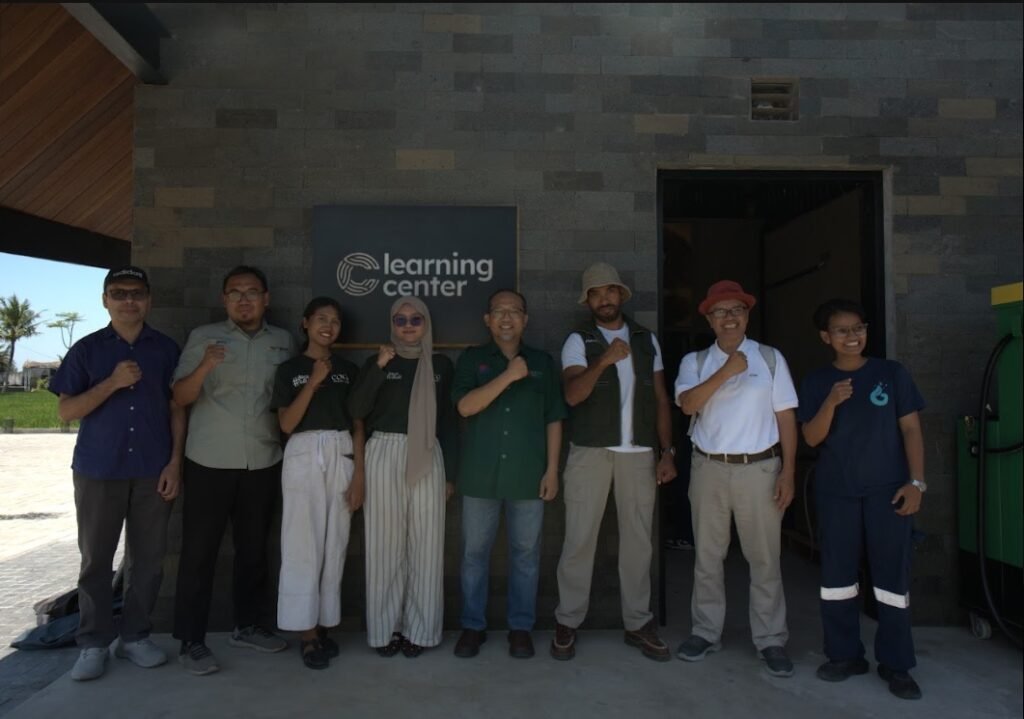
According to the visit request letter, the agenda was clear: hold direct discussions with Cepaka Learning Center’s management, then tour the waste processing facility as a potential reference for future waste technology development.
That detail points to a shift in what Cepaka Learning Center represents. A facility originally built to support community empowerment in Cepaka Village through coastal waste processing is now being weighed as a technical reference by a national research institution. Not every community initiative reaches that point.
Read also: THE SWEEP Bali: How 206.25 Kg of Canggu Plastic Became Alternative Fuel
For a social foundation in Bali like COCO Social Fund, a visit from a research body like BRIN carries weight on two fronts.
One is technical validation. A national research institution doesn’t show up for small talk — it shows up to study a process that’s already running, and that alone signals recognition. The approach at Cepaka Learning Center isn’t a pilot stuck at the testing stage. There are real results worth examining.
The other is the door it opens for longer-term collaboration. Conversations between researchers and field practitioners often lead somewhere: refined technology, replication elsewhere, or research support that strengthens Cepaka Learning Center’s own capacity. For any company weighing a CSR program in Bali, it’s a useful example of how a partnership can grow past one-off donations into something with staying power.
Sit with this for a second: an idea as simple as turning hard-to-recycle plastic into fuel, born out of beach cleanups and environmental education at the village level, is now sitting at the same table as researchers from a national institution.
Impact doesn’t have to be measured by scale from day one. Cepaka Learning Center started as a support facility for local programs, the place where waste collected through events like THE SWEEP Bali gets processed further. The work stayed consistent, the results were measurable, and the story spread on its own terms — eventually drawing far more attention than anyone probably expected at the start.
Attention from an institution the size of BRIN raises the stakes. Expectations for Cepaka Learning Center climb accordingly, not just from local residents or the occasional educational tourism visitor, but from people with a technical background who can evaluate the process far more rigorously.
That’s where consistency matters. The pyrolysis process needs to stay well documented — the type of waste going in, the process itself, the fuel coming out. Transparency here isn’t just about reputation. It’s groundwork, in case collaboration with a research body like BRIN eventually moves into something more formal.
Closing Thoughts: One Visit, Many Possibilities
The BRIN Visit to Cepaka Learning Center marks a new chapter for COCO Social Fund. A facility built to support village-level environmental programs is now drawing interest as a technical reference from a national institution seriously chasing solutions to the waste crisis through a waste-to-energy approach.
Not every visit like this ends in a formal partnership. But one thing is certain: a story about plastic waste turned into fuel, coming out of a small village in Tabanan, has now reached all the way to Jakarta. That alone is worth marking.