Until now, the yard in Cepaka Village that hosts Pasraman Day has usually filled with children practicing dance. On October 24, 2026, the program went a step further. For the first time, COCO Social Fund’s pasraman ran a Balinese dance workshop for the public.
Pasraman at COCO Social Fund
In general, a pasraman is a nonformal Hindu education institution that in Bali also teaches arts, language, and manners. On COCO Social Fund’s official website, Pasraman Day is described as a weekly immersion in traditional arts, character building, and community values.
The fifth edition on July 25, 2026 showed Cepaka Village children practicing dance in the village yard. On September 22, they learned the Sekar Jagat dance.
Open to the Public for the First Time
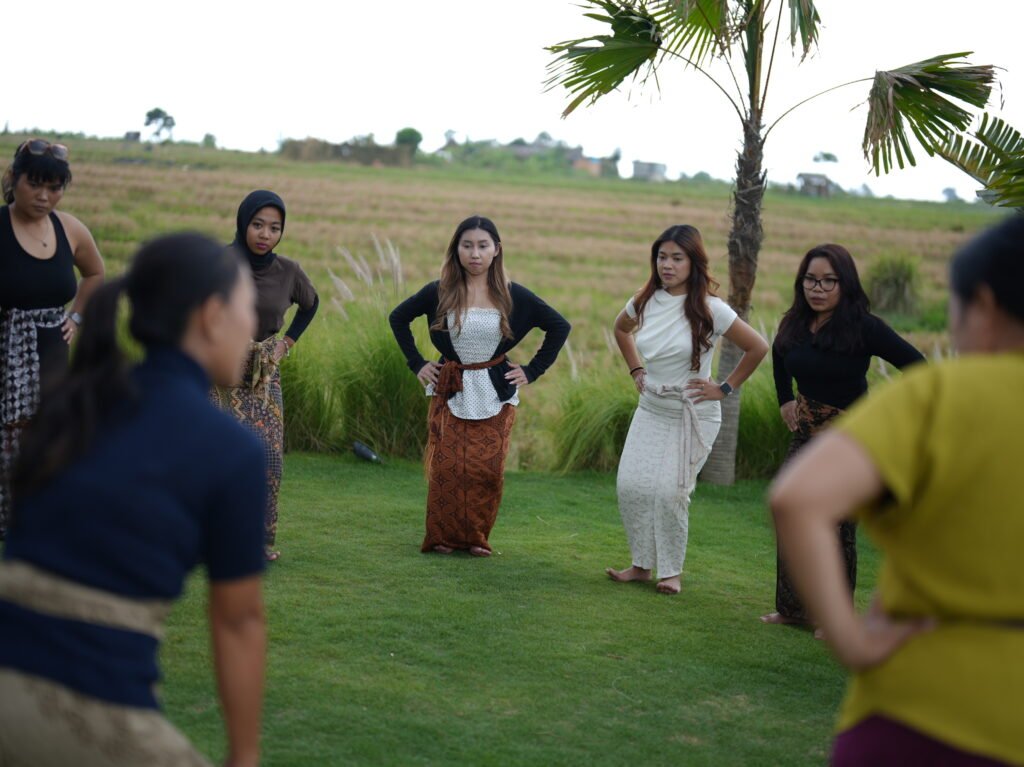
Before October 24, pasraman served children from Cepaka Village. This workshop changes that: members of the public can now join in learning Balinese dance. For a program that has focused on children, the step widens who gets to experience Balinese dance from the inside.
Read also: Pasraman Day COCO Social Fund: The Sekar Jagat Dance as a Lesson in Presence
The Three Foundations of Balinese Dance
In general, Balinese dance rests on three foundations: agem, tandang, and tangkep. The three are regarded as one whole, joining wiraga (body), wirasa (feeling), and wirama (rhythm).
Agem is the core stance that anchors a dance. By where the body’s weight rests, there’s a right agem, with weight on the right foot, and a left agem, with weight on the left foot. Each form of agem follows set standards, as in other classical dance traditions.
Tandang is the way one core movement carries over into another, so the dance flows as a connected sequence. Footwork and the development of hand movements fall within it.
Tangkep is the expression that shows through the face. In Balinese dance teaching, tangkep is seen as deciding a dance’s maturity: without feeling behind it, a dance doesn’t look alive. The eye movement called seledet is also a trait that sets Balinese dance apart from other dances.
Value for the Community and Partners
Balinese cultural preservation needs more hands, and a workshop for the public adds one more way in. For the Bali environmental and cultural community, it’s a place to meet through one shared activity. For other social foundations in Bali, a cultural activity open to everyone offers a new way to bring residents in. For any company weighing a CSR program in Bali, this can be a starting point for collaboration, such as inviting employees or guests to learn local culture through educational tourism.
Closing Thoughts: Watching Balinese Dance With New Eyes
For many people, Balinese dance is something to watch. The Balinese dance workshop for the public at COCO Social Fund’s pasraman turns it into something to try.
If you couldn’t join, you can still get a taste from the audience seat. Next time you watch Balinese dance, look for three things. Notice the body’s stance when the dancer pauses, that’s agem. Notice how they move from one gesture to the next, that’s tandang. Then notice the face and eyes, that’s tangkep. For the next schedule, follow COCO Social Fund’s official channels.